

-
Community & Family Services
- Care Management Program
- Child Support Enforcement Unit
- Family Support
- HCBS Waiver
- Home Improvement Supplement Program (HIP)
- Homeowner's Assistance Fund
- Individual Residential Alternatives (IRA)
- Individual Supports and Services (ISS) - Housing Subsidy Program
- Office of the Family Advocate
- Three Sisters Program
- Tribal Vocational Rehabilitation (TVR)
- Community Partnership Fund
- Economic Development
- Education
- Environment
- Executive Director's Office
- Finance
- Generations Park
- Grants & Contracts
-
Health Services
- A/CDP Outpatient
- A/CDP Prevention
- Partridge House (Inpatient)
- Ronthahiiohsthá:ke Clubhouse
- Business Office
- Dental Clinic
- Health Promotion and Planning
- Laboratory
- Diabetes Center for Excellence
- Medical Clinic
- Mental Health - Kanikonri:ihne (Good Mind Counseling)
- Outreach Chronic Care Nursing
- Pharmacy
- School-Based Health Center
- Home Improvement Supplement Program (HIP)
- Human Resources
- Office for the Aging
- Office of Emergency Management and Safety
- Planning and Infrastructure
- Social Services Division
- Tribal Historic Preservation Office
- Saint Regis Mohawk Tribal Police
The 2023-2027 Lake Ontario Lakewide Action and Management Plan (LAMP) is a binational, five-year ecosystem-based strategy to restore and protect Lake Ontario water quality.
The Lake Ontario LAMP fulfills the United States of America (U.S.) and Canadian commitments under the 2012 Great Lakes Water Quality Agreement (GLWQA, 2012) by assessing ecosystem conditions, identifying environmental threats, setting research and monitoring priorities, and determining further actions for governments and the public.
The LAMP is a model for cooperation among governmental jurisdictions and their management agencies and a resource for anyone interested in the Lake Ontario basin ecosystem, its water quality, and actions to protect this extraordinary Great Lake.
Coordination is undertaken by a binational Working Group, supported by technical work groups, science committees, and coordination teams focused on key themes such as water quality, habitat and species, coastal resilience, and public engagement. These teams coordinate efforts to engage stakeholders to identify priorities for the assessment of current and future potential threats to water quality, and for the identification of priorities to support actions. The Saint Regis Mohawk Tribe (SRMT) Remediation and Restoration (R&R) Program is part of the Lake Ontario Partnership Working Group (LOPWG). Members of the public are essential to the development and implementation of the Lake Ontario LAMP.
Indigenous knowledge—complex, place-based knowledge systems rooted in the worldviews and laws of Indian Nations, First Nations, and Métis—plays an essential role in understanding and caring for Lake Ontario. Traditional Ecological Knowledge (TEK), as one expression of these systems, offers detailed insights into environmental change, species, and relationships among water, land, and all beings. TEK is an independent and sovereign knowledge system that may only be shared at the discretion of Indigenous knowledge holders and in accordance with their protocols.
The Lake Ontario Partnership recognizes the importance of Indigenous-led stewardship and co-development of science and actions under the LAMP. Indigenous governments and organizations help assess lake status, identify priorities, and shape management actions, including through ongoing work under the GLWQA to support better and respectful engagement of TEK and Indigenous knowledge in Great Lakes research, monitoring, and decision making.
Indigenous Peoples First Nations and Indian Nations have deep, longstanding relationships with Lake Ontario, grounded in thousands of years of stewardship, use, governance, and responsibility in relation to the basin's lands and waters. The Lake and its tributaries have sustained communities with food, medicines, transportation routes, and places for ceremony, governance, and trade.
The name “Ontario” itself is derived from the Mohawk word “Oniatarí:io,” often translated as “Beautiful Lake,” and Toronto from “Tkaronto,” “the place in the water where the trees are standing,” reflecting the central role of these waters in Indigenous life and languages.
Today, the Lake Ontario basin remains home to Indigenous communities of diverse nations and groups, including Anishinaabe, Haudenosaunee, and Métis peoples. Their inherent rights, Treaty Rights, laws, and governance systems continue to shape how they care for the lake and its tributaries. Access to healthy waters, wetlands, fisheries, and shorelines is vital for cultural continuity, harvesting, ceremony, and community well-being.
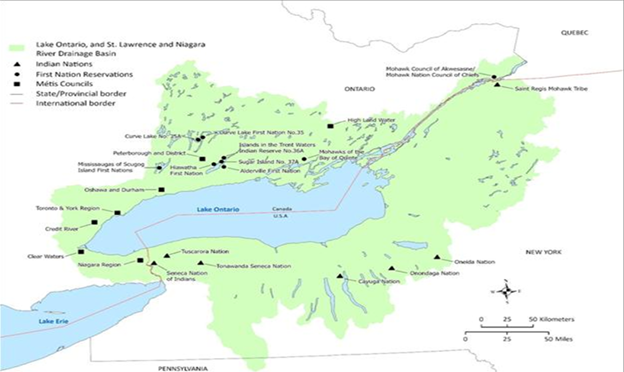
Figure. Map of Lake Ontario, its watershed, and the Indian Nation communities, First Nation communities and Reserve Lands, and Métis Nation Councils in the Lake Ontario basin (ECCC, 2023). Under the GLWQA, the geographic scope of this LAMP includes activities in the waters of Lake Ontario, the Niagara River, and the St. Lawrence River to the international boundary, including tributaries and watersheds as they impact the waters of Lake Ontario.
Public Comment Period – Open through September 25, 2026:
A public review of the draft 2023–2027 Lake Ontario LAMP is an opportunity for feedback to help shape this and future LAMPs.
This page was developed using excerpts from the most recent 2023-2027 Lake Ontario Lakewide Action and Management Plan Available for Public Review and Comment – Binational.net
Please use the Contact Us page to direct your questions and comments by September 25.
Additional Information:
More information about the Great Lakes Water Quality Agreement (GLWQA) go to Binational.net – Canada-U.S. Great Lakes Water Quality Agreement and for more information on Lakewide Management (Annex 2) go to Lakewide Management (Annex 2) – Binational.net.
Joint Release: SRMT and MCA Oppose Renaming of Lake Ontario
Reports: